

The Ministry of Culture, Sports and Tourism has issued Decision No. 393/QD-BVHTTDL dated February 21, 2024, on the announcement of the List of National Intangible Cultural Heritage for 26 heritage sites of provinces and cities nationwide. In which, the social customs and beliefs of the Mo Muong in Dak Lak have been listed in this List of National Intangible Cultural Heritage.
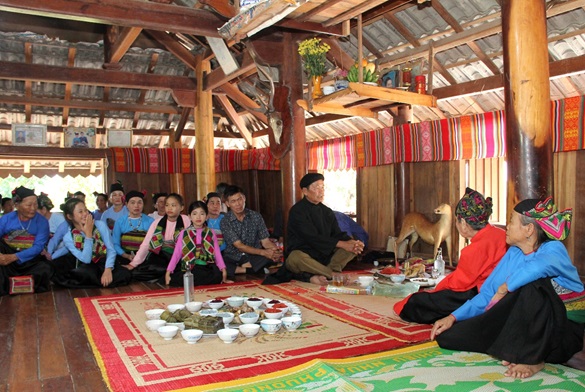
Mo narrates the story of giving birth to land and water at the Upper Longevity Mo Ceremony in Village 9, Ea Pal Commune, Ea Kar District
Mo Muong is a folk cultural performing activity, manifested in rituals associated with the spiritual life of the Muong ethnic people, with high community spirit, profound humanistic values, and significant educational implications for the community.
Mo Muong is associated with the life of the Muong ethnic people from birth to death. Practitioners of Mo Muong are Mo masters, individuals who possess Mo knowledge, memorize Mo verses, and are proficient in rituals, customs, and traditions, earning the trust of the community. Mo Muong is composed of three elements: Mo verses, the performing environment, and the performing subject (Mo artist). Among these, Mo verses are closely linked to the Mo artist and hold the most important position. The content of Mo Muong includes poetic verses, Mo poetry with many folk tales, myths, legends, epic poems reflecting the worldview, philosophy of life, and social life of ancient Muong people.
The Muong people do not have their own writing system, so Mo songs (prayer songs) are passed down from one Mo master to another through oral transmission, preserved and maintained through folk rituals of the Muong people. Currently, Mo Muong is mainly used in funerals or health-seeking ceremonies of the Muong people. According to statistics from the Cultural Heritage Department, Ministry of Culture, Sports and Tourism, the Mo Muong heritage still exists in 7 provinces and cities.
In Dak Lak, the Muong people live in districts such as Ea Kar, Krông Năng, Ea H’leo, Krông, and Buon Ma Thuot City. From 2022 to 2023, Dak Lak province collaborated with the National Institute of Music and provinces with Mo Muong heritage to build a national dossier submitted to the United Nations Educational, Scientific and Cultural Organization (UNESCO) for inscription in the List of Intangible Cultural Heritage in Urgent Need of Safeguarding.Kim Bao
- Focus on accelerating the Progress of key regional Projects (23/04/2026, 09:33)
- World Coffee Heritage Forum – A Space for Dialogue Connecting Global Coffee Culture and Knowledge (23/04/2026, 09:27)
- Fourth Executive Committee Conference of the Provincial People's Committee (Term 2025-2030) (23/04/2026, 09:23)
- Chairman of the People's Committee of Dak Lak Province works with HAIAN Buon Don Joint Stock Company (23/04/2026, 07:38)
- Chairman of the Provincial People's Committee Do Huu Huy: Resolutely addressing challenges for projects in Nam Phu Yen Economic Zone (23/04/2026, 07:33)
- Strengthening the Special Friendship between Dak Lak Province and Savannakhet Province (Laos) (09/04/2026, 09:14)
- The Standing Committee of the Dak Lak Provincial Party Committee visits and extends Bunpimay Traditional New Year greetings in Champasak Province (Laos) (09/04/2026, 08:35)
- The Provincial People's Committee provides opinions on the Report on adjustments to the Dak Lak Provincial planning for the 2021-2030 period, with a vision to 2050 (09/04/2026, 08:11)
- The Durian Festival of Dak Lak Province 2026 will take place over two weeks (09/04/2026, 08:06)
- Dak Lak Participates in the Forum on Investment, Trade, and Tourism Cooperation to Promote East West Economic Corridor Connectivity in 2026 in Laos (09/04/2026, 08:02)
- Deputy Prime Minister Ho Quoc Dung inspects field work on Khanh Hoa - Buon Ma Thuot Expressway Project (20/03/2026, 09:51)